How Do I Check a TikTok Transcript Quote Before Sharing It?
By TranscriptNest · Published 2026-10-21
Replay the original audio before sharing a quoted line
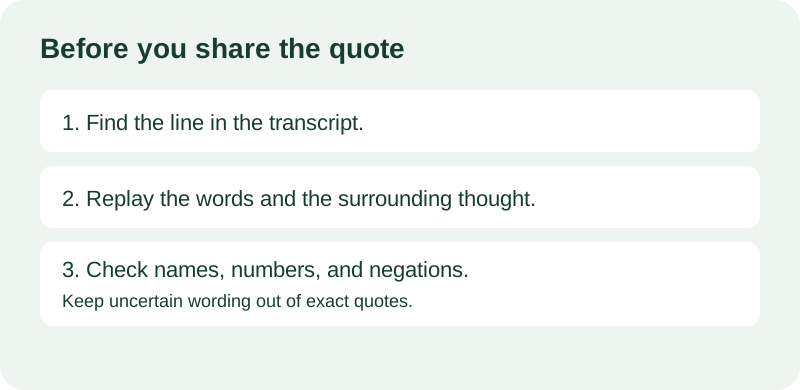
Use the transcript to locate a line, then play the original clip and check the words you plan to quote. Listen to the sentence before and after it as well: a clean-looking excerpt can lose a condition, correction, or response when separated from the exchange. If you cannot hear a word clearly, do not silently fill it in from context. Mark it for review or leave it out of a word-for-word quotation.
Check high-impact words and the surrounding context
Review the parts most likely to reverse or narrow a claim: negations such as not or never, names, dates, quantities, comparisons, and short qualifiers such as only or unless. Play a small section around each one rather than trusting a plausible sentence on the screen. Then replay the full thought once to check that the speaker's point still has the same scope. This is a practical review order, not a measured error-rate ranking.
Keep a quote-check note with the source
For a quote you expect to reuse, make a short private note with the exact text you intend to quote, the source post or file, the date you checked it, and a locator you can reproduce. A transcript from this tool is plain text without timestamps, so it cannot supply a timecode; use the source player's controls to find the moment yourself and record a locator only if you verified it. Keep the generated transcript and any corrected quotation in separate files so a later reader can tell which words came from the automatic output and which you checked.
Illustrative example: a missing 'not' changes the meaning
Invented example, not a real TikTok quote or transcription test: suppose a transcript says, 'I would recommend the update,' while a quick replay sounds like 'I would not recommend the update.' Do not choose the version that seems more logical. Replay the phrase, listen for the short negative, then review the full sentence and the response around it. If the word remains unclear, avoid presenting either version as an exact quote until you can verify it.
What the transcript can and cannot establish
A transcript is a convenient reading aid, not independent evidence that every word is correct. The Oral History Association's primer recommends checking a draft against a copy of the recording and checking uncertain names and facts; the Library of Congress quotation guide likewise treats source identification and context as part of quote verification. Those are general research practices, not TikTok platform rules. For an important public claim, link readers to the original post when appropriate and make clear which wording you personally checked.
Use TranscriptNest as a draft, then review it
TranscriptNest can accept a local audio or video upload and return text for copying or download. Its current output is plain text without timestamps, and the page asks users to review AI-generated text for errors. It does not independently certify a quote or verify a speaker's identity. Keep the original media available while you check a line, and use only content you own or are authorized to process.