Should You Include Background Music in a TikTok Transcript?
By TranscriptNest · Published 2026-11-08
Transcribe the spoken words first; add a short sound cue only when it helps explain the moment
For a TikTok transcript, keep the speaker’s words as the main record. Add a brief, clearly labeled cue for music or another sound only when it changes how a line is understood or helps a reader follow the scene. If music masks a word, mark that span as unclear instead of filling it in from context. The Smithsonian’s audio instructions use bracketed labels for significant sounds and say continuous background noise can be noted once at the beginning of a project; those are Smithsonian project conventions, not a universal TikTok rule. TranscriptNest has not been verified for detecting or labeling background music and sound events, so check every cue against the recording.
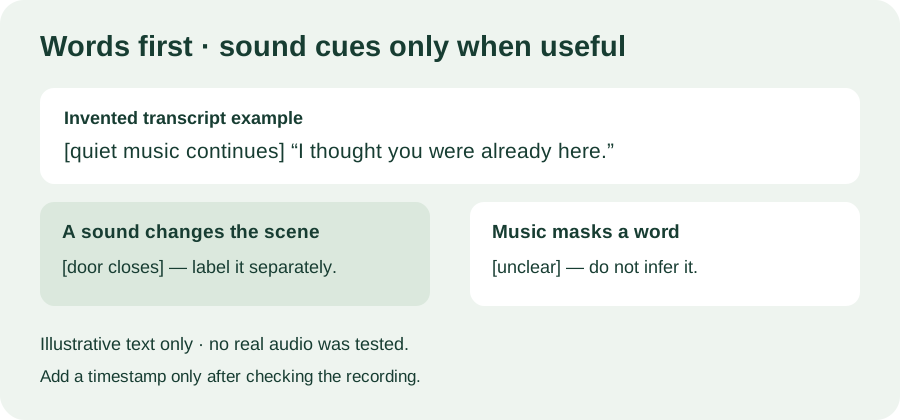
Decide whether a sound belongs in the transcript
Use a purpose check rather than trying to describe every audible detail. Ask: would leaving this sound out make a reader misunderstand who is speaking, miss an interruption, or lose a meaningful reaction? If yes, add a concise cue. If a quiet music bed continues under the whole clip and does not change the speech, a single note at the start may be enough for a transcript whose readers need that context. If the goal is only to preserve spoken wording, the sound may not need a cue. The right choice depends on the transcript’s intended use; the article’s checklist is an editorial aid, not a platform requirement.
Keep sound cues separate from words you heard
Do not place a sound description where a spoken word would go without marking it as a sound. Use one consistent visual form, such as square brackets, and describe only what is audible: for example, [brief music swell] or [door closes]. Avoid guessing the source of an indistinct sound. If the recording makes it unclear whether a sound is music, a notification, or a voice, say that it is unclear rather than inventing a source. Keep any speaker labels, sound cues, and spoken text visually distinct so a later editor can tell what was heard as speech and what was added as a note.
Invented example: separate speech from a sound event
This example is invented and is not from a real TikTok clip or a tool test. Suppose a short video has a low music bed, then a sharp door sound while a person says, “I thought you were already here.” A readable note could place [quiet music continues] at the beginning and [door closes] beside the line only if that sound changes the scene for the intended reader. The words stay exactly as spoken. If the music covers the first word and you cannot hear it, write [unclear] for that span in a separate review copy; do not reconstruct a likely sentence and present it as heard.
Add timestamps only when you verify them from the actual recording
A sound cue does not automatically need a timecode. For a plain reading transcript, a short cue near the relevant sentence may be sufficient. For a caption or timed transcript, use a timestamp only after locating the sound in the media and checking that the cue appears at the right moment. Never invent a time from memory or from an illustrative example. Smithsonian’s audio workflow treats timestamps as part of captions aligned to its media player; that is useful guidance for timed work, but it does not make every ordinary text transcript a subtitle file.
Should I write down every instance of background music?
Usually, a transcript does not need a repeated label for a continuous sound that never changes. If the intended reader needs to know the sound is present, use one note near its start and add another cue only when it changes or becomes important. If your project or client has a specific style guide, follow it instead of this general editorial suggestion.
What if the music makes a word hard to hear?
Replay the short phrase and check the audio around it. If the word remains masked, leave it unresolved with a consistent marker such as [unclear]. Keep the sound cue separate from that marker. Do not infer a lyric or spoken word from the topic, the video caption, or what would make the sentence grammatical.