How to Redact Personal Information from a TikTok Transcript
By TranscriptNest · Published 2026-10-26
Keep a private original and redact a separate copy
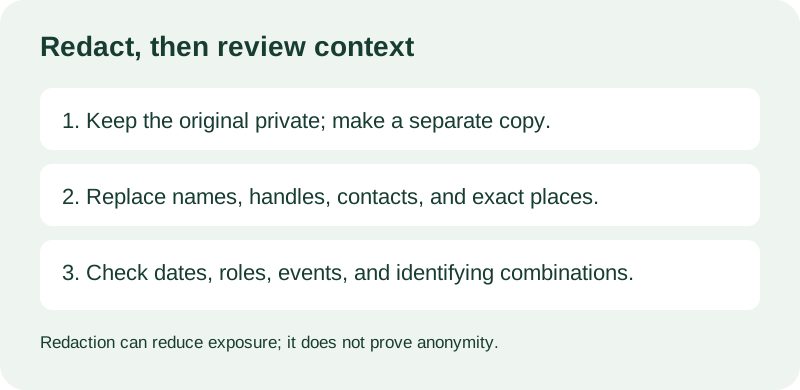
Before sharing a TikTok transcript, keep the untouched source text in a private location and make a separate copy for redaction. Remove or replace names, handles, phone numbers, email addresses, exact addresses, account numbers, and other details that identify a person. Then check the remaining context: a job title, small town, unusual event, or exact date can identify someone when combined with other public details. Use a consistent marker such as [PERSON A] or [CITY] and do not call the result anonymous just because a name is hidden. NIST describes privacy risk as context-dependent and warns that simply masking fields may not be enough for de-identification.
Start with direct identifiers, then look for identifying combinations
NIST SP 800-122 explains how personally identifiable information can identify or be linked to an individual, and recommends context-based protection. For a transcript, scan first for direct identifiers: a person's full name, username, phone number, email, precise location, or a visible account ID spoken aloud. Next, look for combinations that narrow the person down. A first name alone may be broad; a first name plus a small town, workplace, niche role, and event date may point to one person. NIST SP 800-188 distinguishes direct identifiers from quasi-identifiers and describes evaluating disclosure and re-identification risk. These are federal information-protection publications, not a platform-specific TikTok rule or a guarantee that a casual edit meets a legal standard.
Use a replacement that preserves only the meaning you need
Illustrative example only: imagine a speaker says, “I’m Jamie, the only night nurse at Pine Street Clinic, and my shift ends at 11.” If readers only need to understand the speaker's schedule, a redacted copy might say, “I’m [PERSON A], a nurse at [CLINIC], and my shift ends at [TIME].” If the exact time is irrelevant, replace it too. If the location or role is necessary to the point, consider generalizing it instead of deleting the whole sentence: “I work in healthcare in [REGION].” Keep the same marker for the same person throughout a copy so the conversation remains readable. Do not substitute a guessed name, invented place, or plausible-sounding detail; that changes the transcript instead of redacting it.
Review what the surrounding story still reveals
After replacing obvious details, read the transcript as a stranger would. Ask whether a public profile, local news item, employer page, or event announcement could connect the remaining facts to one person. Check names in quoted stories, relationships, school or workplace references, rare occupations, exact dates, and distinctive incidents. Remove, broaden, or suppress a combination when it is not needed for the reader's purpose. NIST SP 800-188 describes assessing disclosure risk and notes that masking alone may not provide enough functionality for de-identification. A text-only review cannot prove that a person is impossible to identify, especially when the video, voice, username, or background remains public.
Keep a small edit note and do a second pass
Make a short private note of the categories you changed, such as “replaced names and handles; generalized location; removed exact date.” Then compare the redacted copy with the private original to confirm that every intended identifier is handled consistently and the wording still reflects what was said. A second reviewer can check for missed details if the transcript will be shared widely. Do not include the original identifiers in a public change note. If the clip itself remains accessible, removing details from a transcript does not remove them from the video or make the speaker unidentifiable.
Does replacing a name make a transcript anonymous?
No. Replacing one name can lower exposure, but other details may still identify the speaker or someone mentioned. NIST's glossary describes de-identified information in terms of enough identifying information being removed or obscured that the remaining record does not identify an individual and there is no reasonable basis to believe it can be used to do so. The standard is broader than a name search. Treat a lightly edited transcript as redacted, not as proof of anonymity, unless an appropriate review supports that stronger claim.
Can I redact the only transcript copy?
For careful review, keep an untouched copy in a private place and redact a duplicate. This lets you verify that the edit did not accidentally change a quote or remove context needed to understand the speaker. Share only the version needed for your purpose, and avoid placing the unredacted original in a public document or change log.