How to Review a Code-Switched TikTok Transcript
By TranscriptNest · Published 2026-11-06
Keep the words in the language that was spoken, then review every switch against the audio
A code-switched TikTok transcript can move between languages in one sentence. Preserve the spoken words in their original language and writing system in your transcript; do not silently translate them into English. Play the audio around each switch, check the words on both sides, and put any translation in a separate, clearly labeled version. If a short phrase remains unclear, mark it as unresolved instead of choosing the word that makes the sentence sound most natural. TranscriptNest accepts uploaded audio and video, but we have not verified its accuracy on code-switched speech or any particular language pair.
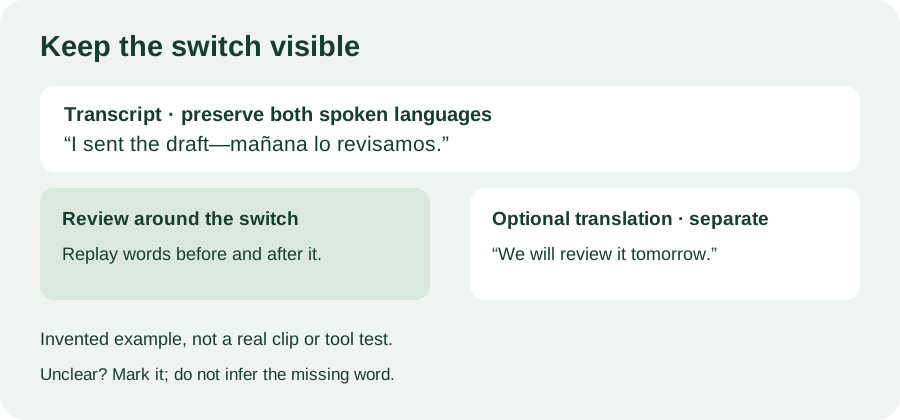
Why a mixed-language line needs its own review pass
A transcript can look fluent while losing the moment a speaker changes language. A word may be replaced by a similar-sounding word from the other language; a phrase may be translated rather than transcribed; or a proper name may be normalized into an unrelated common word. These are review risks, not a claim that every system makes them. The ACL Anthology describes a German-English speech benchmark with different degrees of code-switching and notes that data for every language pair is difficult to collect. That is a reason to review the actual recording and avoid generalizing one tool result to every pair.
Use a four-pass check without rewriting the source
First, save the initial transcript as a raw copy. Second, listen once and mark approximate language-switch points without changing words. Third, replay a short segment before and after each point: confirm the final word in the first language, the first word in the next language, and any short connecting word. Fourth, make corrections in a separate review copy and keep unresolved spans visibly unresolved. This sequence makes it easier to compare the first output with later edits; it is an editorial workflow, not a transcription standard imposed by TikTok.
Invented example: preserve a switch and separate the translation
The following line is invented for this guide; it is not from a TikTok video or a tool test. Spoken line: “I sent the draft—mañana lo revisamos.” A transcript that preserves the switch keeps those words in that order. A separate translation note could read “We will review it tomorrow.” Do not replace the Spanish words with that English sentence inside the transcript itself. If the audio instead makes the first word sound like “mañana” or “manana” and the spelling matters to your use, replay it and verify the written form; do not infer spelling from the sentence alone.
Keep transcription, transliteration, and translation separate
These are different editorial operations. Transcription records what you hear in the language’s written form. Transliteration represents sounds with another writing system and can lose distinctions. Translation expresses meaning in another language. If a reader needs all three, store them in separate fields or versions, for example: original words, optional pronunciation aid, and optional translation. Smithsonian’s volunteer guidance is for its document projects, not a universal spoken-language rule, but it explicitly tells transcribers to keep non-English text in its original language and not translate it. Treat it as a useful preservation example and follow any project-specific instructions for your own work.
What if you do not know one of the languages?
Do not guess from context. Replay the exact span, ask a qualified speaker to review it when the words matter, or mark the span as unclear under a consistent notation. Keep the original audio and the untouched first transcript so a later reviewer can revisit the same segment. If you add a translation, label who prepared it and keep it separate from the spoken-word record. A plausible translation is not evidence that the original words were heard correctly.
Does code-switching mean the transcript is wrong?
No. Switching languages is part of the recording, not automatically an error. The transcript may still contain recognition mistakes, so check the audio around each switch. Research benchmarks study particular language pairs and test data; their findings do not certify a specific consumer tool or an untested language pair.
Does TranscriptNest guarantee code-switched accuracy?
No. TranscriptNest has not been validated here against a code-switched speech benchmark. You can upload a file to receive text, then review the result against the recording; do not treat the output as verified merely because it contains both languages.