Should I Remove Filler Words from a TikTok Transcript?
By TranscriptNest · Published 2026-10-24
Usually, keep the first transcript unchanged and edit a separate copy
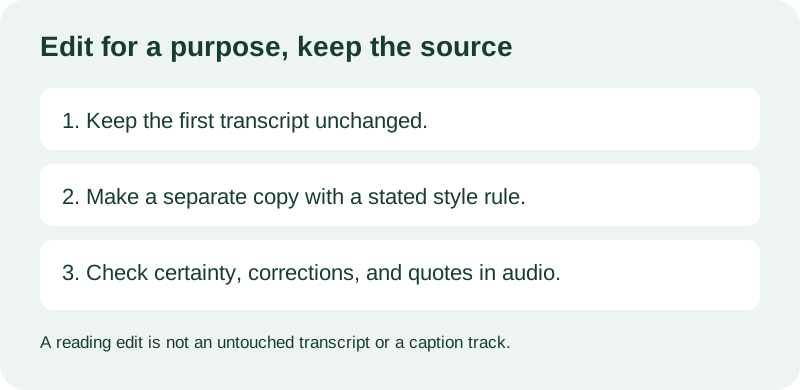
Do not erase every “um,” “ah,” or repeated phrase from your only transcript. Preserve the first output, then make a separate reading copy and state the editing rule you followed. Whether to remove a filler depends on the transcript’s purpose and its house style. The Library of Congress Veterans History Project, for example, tells its transcribers to omit some “um” and “ah” expressions while preserving sentence fragments and incorrect grammar. That is one project’s convention, not a universal TikTok rule. If a change affects certainty, emphasis, or the words being quoted, replay the source and keep the distinction visible.
A transcript style is a choice, not a platform rule
The Library of Congress Veterans History Project describes a word-for-word transcript but asks its transcribers to omit expressions such as “um” or “ah.” It distinguishes these from response sounds such as “um-hum” when they mean yes or no, and says not to rewrite fragments or incorrect grammar into standard prose. It also asks editors to indicate when and how a transcript differs from the recording. These instructions belong to that project's oral-history workflow. They illustrate why a transcript should name its convention instead of presenting one cleanup style as mandatory for every TikTok clip.
Separate harmless disfluency edits from meaning changes
A short hesitation can be removed for a reading copy when it adds no information under your chosen style. But do not let a smoother sentence quietly make the speaker sound more certain. For example, this invented line—“I, uh, I think the cut starts at nine”—could be shortened to “I think the cut starts at nine” in a clean-reading copy. Changing it to “The cut starts at nine” also removes “I think,” which changes the speaker’s level of certainty. That second edit is not just filler cleanup. Recheck the audio before changing words that carry a correction, qualification, disagreement, or response.
Use a small, repeatable cleanup policy
Before editing, decide what your copy is for. A searchable reference transcript can stay close to the first output. A reading copy may omit non-meaningful fillers if you do so consistently. An exact quotation should be checked against the recording and should not hide wording changes that matter to the claim. Keep the raw text untouched, save edits under a new filename, and write a brief note such as “Removed non-meaningful fillers; checked quoted sentence against audio.” This lets another reader understand what changed without mistaking an edited transcript for the unaltered output.
A worked example: one pause, two different edits
Illustrative example only, not a measured transcript: imagine the audio says, “I, um, I sent the first file—no, the second file.” A clean-reading version might remove “um” but retain the correction: “I sent the first file—no, the second file.” A careless rewrite to “I sent the second file” may be easier to read, but it hides the speaker's self-correction. If the correction matters to your use, keep it or mark the copy as edited and describe the change. Do not use punctuation to imply a pause or emphasis you did not check in the recording.
Does removing fillers create captions?
No. Editing filler words changes the text; it does not add the start and end times needed for timed subtitle cues. If you need captions for a video you own or are authorized to edit, prepare and review a timed caption file separately. A plain text transcript can help you locate the words, but it is not by itself a synchronized subtitle track.
Should I delete every “um” and “ah”?
No universal rule applies. Use the style required for your project, preserve the original output, and avoid edits that alter uncertainty or meaning. A source-specific convention can guide your decision, but it should not be presented as a TikTok requirement.