How to Transcribe Decimals, Prices, and Digit Sequences
By TranscriptNest · Published 2026-11-11
Keep the first transcript faithful, then make formatting choices visible
For a TikTok transcript that contains a decimal, price, or spoken string of digits, first preserve what you can actually hear. If you want a cleaner numeric display, make a separate, labeled copy and keep the original text available for comparison. The Smithsonian Transcription Center's audio project guide says not to spell out numbers and dates unless the speaker does so. That is a documented project convention, not a universal TikTok rule. A separate Library of Congress National Library Service style sheet also gives its own conventions for percentages, measurements, and currency; it is useful evidence that style depends on the project, not permission to silently rewrite a speaker's words.
Replay decimal places instead of rounding by intuition
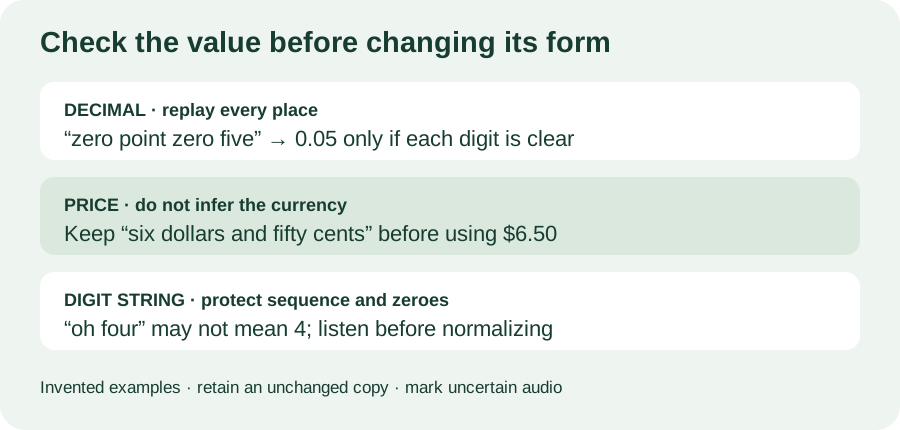
A decimal point and each digit after it can change the amount. Replay the whole phrase, not only the final number: note whether the speaker says “point,” “dot,” or a sequence of digits, and preserve leading or trailing zeroes when they are spoken and relevant. Do not round, convert units, or add precision because a value looks more familiar. If the recording does not make the place value clear, retain the audible words or mark the uncertainty using the project's stated convention.
Do not infer a currency or conversion
A spoken price may name a currency, omit it, or use a shorthand that depends on context. Keep the actual words in a close transcript. Only use a currency symbol in a separate normalized copy when the spoken currency is clear and the style rules call for it. Do not infer dollars from a country, a logo, an on-screen symbol, or a product price elsewhere in the clip. Never convert the amount to another currency as if the speaker had said that value.
Protect digit strings and leading zeroes
Phone-like numbers, product codes, account references, and model numbers are often read digit by digit. Keep the sequence in the order spoken and do not remove a leading zero just because a spreadsheet or formatting rule might. Listen for distinctions such as “oh” versus “zero,” repeated digits, and a pause that separates groups. Do not publish or expose a private identifier merely because it was spoken; follow the privacy and consent requirements for the recording.
A short review pass for numeric phrases
Use a repeatable check: save the raw transcript; mark each number phrase; replay it with the surrounding sentence; compare every digit and decimal place; record uncertainty rather than filling it from context; and make any display normalization in a second copy. This order separates listening evidence from editorial preference. It also makes corrections reversible: another reviewer can see which part came from the audio and which part came from a formatting decision.
Invented example: one phrase, two clearly labeled forms
This example is invented and is not a real TikTok transcript or a TranscriptNest accuracy test. Imagine a speaker says, “It was zero point zero five dollars, and the code starts oh four.” A close draft could retain those words exactly. If a project style permits normalization, a second copy might display “$0.05” while retaining the code as “oh four” or converting it to “04” only if the sound and style both support that choice. The leading zero matters; “0.5” is a different decimal. If the audio does not make the currency or code clear, leave the close wording unchanged and flag the uncertainty instead of guessing.
What this tool has not been verified to do
TranscriptNest has not been specifically tested for decimal-place recognition, currency identification, or preservation of leading zeroes. Compare generated text with the source recording before sharing or using a number for a decision. This guide is a human review workflow, not a claim that the tool validates prices, detects currencies, or corrects numeric errors.
Should you convert every spoken price to a currency symbol?
No. Keep a close transcript first. A symbol is a formatting choice and may imply a currency the speaker never named. If you create a normalized reading copy, use a documented project rule, preserve the spoken value, and keep the original so the choice can be checked.