How Should Numbers Be Written in a TikTok Transcript?
By TranscriptNest · Published 2026-11-10
Choose a number style, then keep the spoken meaning
If you are unsure how to write a number in a TikTok transcript, first decide whether you are keeping a close word-for-word draft or making a clearly labeled reading copy. Preserve the value the speaker actually said, and replay the audio before changing a digit, date, price, or measurement. The Smithsonian Transcription Center uses numerals for numbers and dates unless the speaker spells them out, but that is its project style—not a universal TikTok rule. A consistent transcript style is useful only when it does not replace an uncertain word with a guess.
Keep the first transcript before normalizing numbers
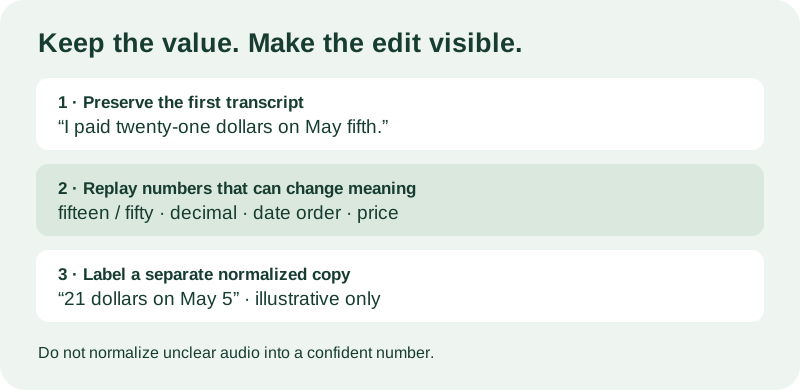
Save the initial transcript unchanged. If you want numerals for easier scanning, make a separate normalized copy and record the rule you used. For example, a project may render a clearly spoken “twenty-one” as “21”; that changes the written form while preserving the intended value. Do not quietly mix “twenty-one,” “21,” and “twenty 1” in one document unless the source truly changes form or your style guide calls for it. Label the copy “normalized for readability” so another reader does not mistake your formatting choice for a different spoken number.
Replay the numbers that are easy to confuse
Numbers deserve a focused review because nearby sounds can change the meaning: fifteen versus fifty, thirteen versus thirty, a decimal point, a negative sign, or one digit in an account or model number. Replay the exact phrase at normal speed, then use a slower speed if needed. Listen to the surrounding sentence as well; grammar can reveal a possible mismatch, but context is a reason to check the audio, not permission to select the number that seems most plausible. If the recording does not resolve it, mark the uncertainty according to your project convention instead of inventing precision.
Invented example: separate the spoken form from the display form
This example is invented and is not from a real TikTok or a TranscriptNest test. Imagine a creator says, “I paid twenty-one dollars on May fifth.” A close text draft could keep “twenty-one” and “May fifth.” A separately labeled normalized copy might use “21 dollars” and “May 5,” if that is the chosen style. Before normalizing, replay the clip to confirm the amount and date. The two versions communicate the same intended values in this example, but they are visibly different editorial forms; keep the original draft so the change can be reviewed.
Do not resolve an ambiguous date from context alone
A spoken date such as “four five twenty-six” can be difficult to interpret without knowing the speaker’s date convention. Do not convert it to a calendar date unless the wording or reliable context makes the order clear. In a close transcript, preserve the spoken phrase. In a normalized copy, add a note such as “date order not confirmed” or retain the original wording. The same principle applies to times, measurements, prices, scores, and abbreviations: formatting should make the transcript easier to read without pretending that unclear audio became certain.
What the transcript tool has not been verified to do
TranscriptNest has not been tested for number-specific recognition or automatic number normalization. Treat any generated number as text to review against the source media, especially when one digit changes the meaning. This guide describes a human checking and editing method; it does not claim that the site detects dates, validates prices, or corrects numeric errors.
Should every spoken number be changed to digits?
No universal rule applies to every transcript. Follow the style required by your project, keep it consistent, and identify any normalized copy as an edit. If no project style exists, retaining the initial wording and making a separate, clearly labeled reading copy keeps the editorial choice reversible.